· Maya Colton
Can you sleep in toe spacers? A careful, honest guide
Sleeping in toe spacers sounds efficient: eight free hours where your toes get spaced without costing you a minute of your day. I understand the appeal, and I will not pretend nobody does it, because plenty of people do, including some of my coaching clients. But of all the questions I get about spacers, this is the one where I pump the brakes hardest. Asleep, you lose the one safety system that makes daytime wear so low-risk: your attention. Here is how to think about overnight wear, who should skip it entirely, and the slow way in if you decide to try.
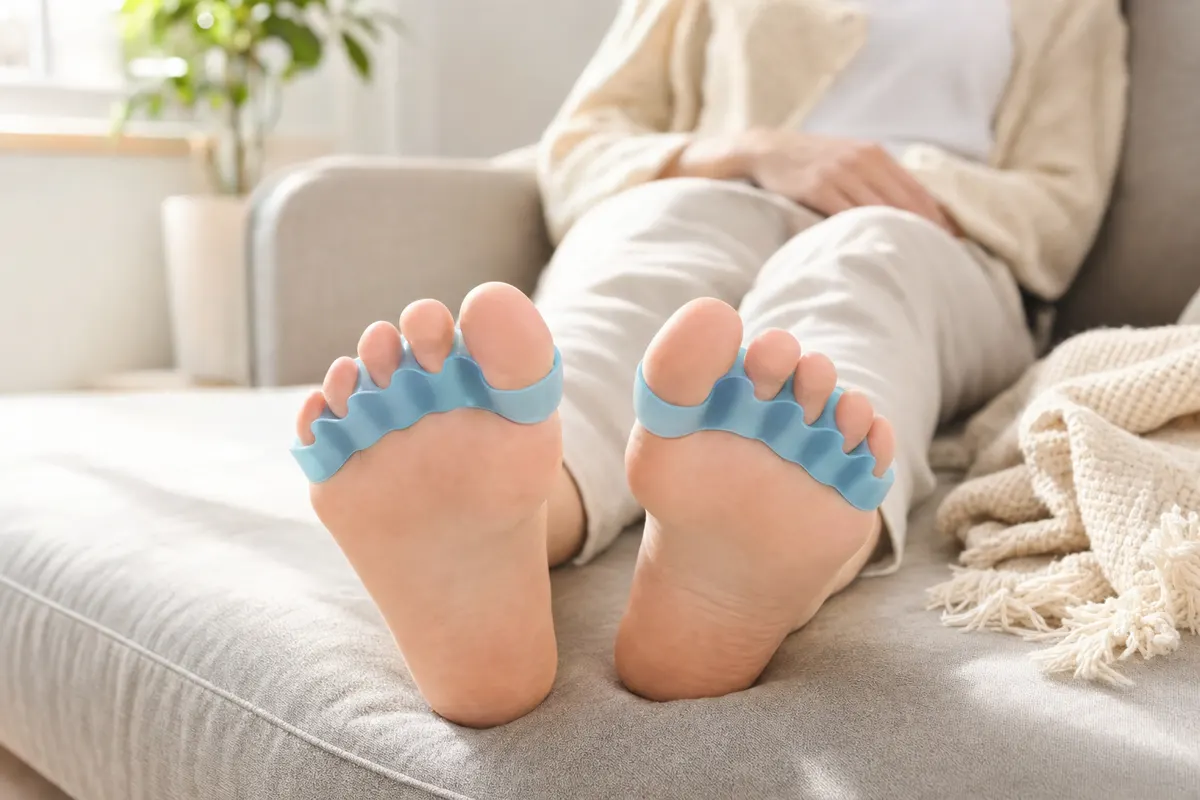
Why nighttime is different from daytime
During the day, your body runs constant quiet feedback. If a spacer starts pressing a nerve or a toe begins to tingle, you notice within seconds and adjust. That feedback loop is exactly what I lean on in my wear-time guide, where the stop signals, pain, numbness, tingling, matter more than any timer. Asleep, those signals have to be strong enough to wake you, which means a mild problem can quietly continue for hours. Feet also swell and shift temperature overnight, and a fit that was fine at 10 p.m. can feel snug by 3 a.m. None of this makes overnight wear reckless for everyone; it makes it a privilege you earn through adaptation, not a starting point.
Who should not sleep in toe spacers
Be honest with yourself about these exclusions. Skip overnight wear entirely if you have diabetes, neuropathy, or any condition that reduces sensation in your feet, because the entire safety case for sleeping in spacers rests on being able to feel a problem. Skip it if you have circulation issues, if your toes ever go numb during normal daytime sessions, or if you are still in your first weeks of use. And to state our standing position clearly: toe spacers are comfort products, not medical devices. If you have persistent foot pain, see a podiatrist before experimenting with overnight anything. With nearly one in four adults aged 18 to 65 having some degree of hallux valgus (Nix et al., 2010), plenty of readers here have exactly the kind of sensitive forefoot that deserves a professional opinion first.
The slow way in: a four-stage progression
If none of the exclusions apply and you still want to try, do it the way I coach it: as the final stage of a progression, never as night one.
| Stage | What to do | Move on when |
|---|---|---|
| 1. Daytime base | Follow the standard 15-30 minute daily routine for 2-3 weeks | One hour awake feels like nothing |
| 2. Long evenings | Wear spacers for a full relaxed evening, 2+ hours | Zero soreness the next morning |
| 3. Nap test | Keep them on for a daytime nap or a lie-in | You wake with no marks, no numbness |
| 4. Overnight | Try a full night, ideally a night before a rest day | Only continue if mornings feel completely normal |
At every stage, the rule from my wear-time guide still applies: pain, numbness, or tingling means off, immediately, and back to the previous stage. There is no schedule worth overriding that for.
Fit rules for overnight wear
Never tight. A spacer you sleep in should feel almost loose. If you have to work it between your toes, it does not belong there overnight. Soft materials only. This is a job for a soft gel five-toe spacer like our $19.99 pair, not for firm walk-oriented spacers; firmness that is useful for standing wear, as in the premium competitor we compared, is exactly what you do not want pressed between relaxed toes for eight hours. Consider a single tube instead. If your concern is one toe, a fabric-covered separator tube (per our 2026 measurements, S ring 3 x 1.5 x 2 cm, L ring 3.2 x 1.8 x 2.2 cm; 3-pack $19.99, 6-pack $24.99) is a gentler overnight experiment than a full five-toe spacer, because it involves less total material and less to shift around. Warm feet, loose bedding. A tucked-tight sheet pressing your spaced toes sideways defeats the purpose; give your feet room.
What overnight wear will and will not do
Manage expectations the same way we do everywhere on this site, including our honest look at whether spacers work: more hours of gentle spacing means more time your toes spend decompressed, and many overnight wearers say their feet feel noticeably relaxed in the morning. What the extra hours will not do is turn a comfort tool into a realignment device. The evidence for permanent realignment from spacers is limited at any wear time, and sleeping in them does not change that. If someone promises you that nighttime wear straightens toes for good, they are selling, not informing. Our testing methodology and verified buyer reviews stick to what we can actually observe.
My bottom line
Can you sleep in toe spacers? After weeks of comfortable adaptation, with soft gel, a loose fit, healthy sensation in your feet, and a strict take-it-off rule: cautiously, yes, some people can and do. Should you start there? No. The evening routine delivers most of the comfort with none of the unattended risk, which is why it remains my default recommendation. If you are building your setup, the Complete Toe Comfort Kit at $39.99 instead of $44.98 covers both the gel pair and the tubes, everything ships with a 30-day money-back guarantee and tracked shipping, and you can always email us or browse the rest of the guides, including pairing spacers with barefoot shoes, before you decide.
Toe spacers are comfort products, not medical devices. If you have persistent foot pain, see a podiatrist.