· Maya Colton
Barefoot shoes and toe spacers: why the combo works
If you have found your way to barefoot or minimalist footwear, you have already accepted the core idea: feet work best in the shape they were born with, toes spread, not tapered to a point. Toe spacers are the natural companion to that philosophy, and in the barefoot community the pairing has quietly become standard practice. As a movement coach who has spent five years in wide toe box shoes, here is how the combo actually works, where each tool fits, and the one mistake that ruins it for beginners.
Two tools, one idea
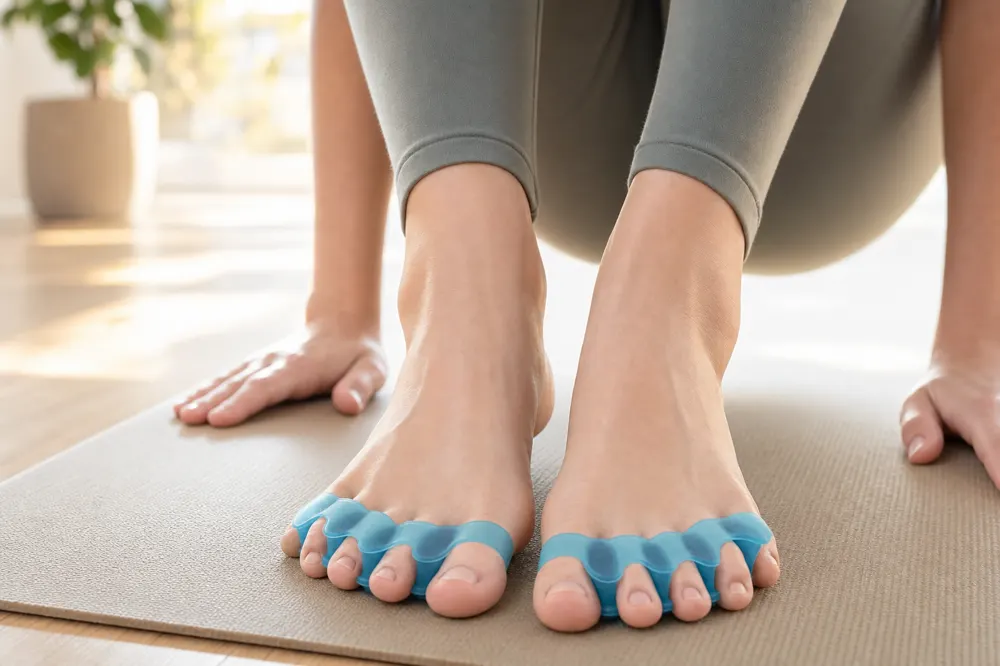
Conventional shoes taper. Wear them for a decade or three and your toes learn to live pressed together; a widely cited review by Nix and colleagues (2010) found that 23% of adults aged 18 to 65 have some degree of hallux valgus, the big-toe drift that narrow footwear is widely believed to encourage. The barefoot movement attacks the problem from the outside in: a wide toe box stops the daily squeeze. Toe spacers attack it from the inside out: soft gel between the toes gently spaces them and gives the foot a daily reminder of its natural width. Neither tool permanently reshapes anything on its own, and we are not going to pretend otherwise; you can read our honest assessment of what spacers do. But the two reinforce each other in a way that each alone does not: the shoes protect the width, the spacers rehearse it.
How to run the combo, day by day
| Moment | Tool | Why |
|---|---|---|
| Daytime, out and about | Wide toe box shoes | No squeeze, toes splay naturally with each step |
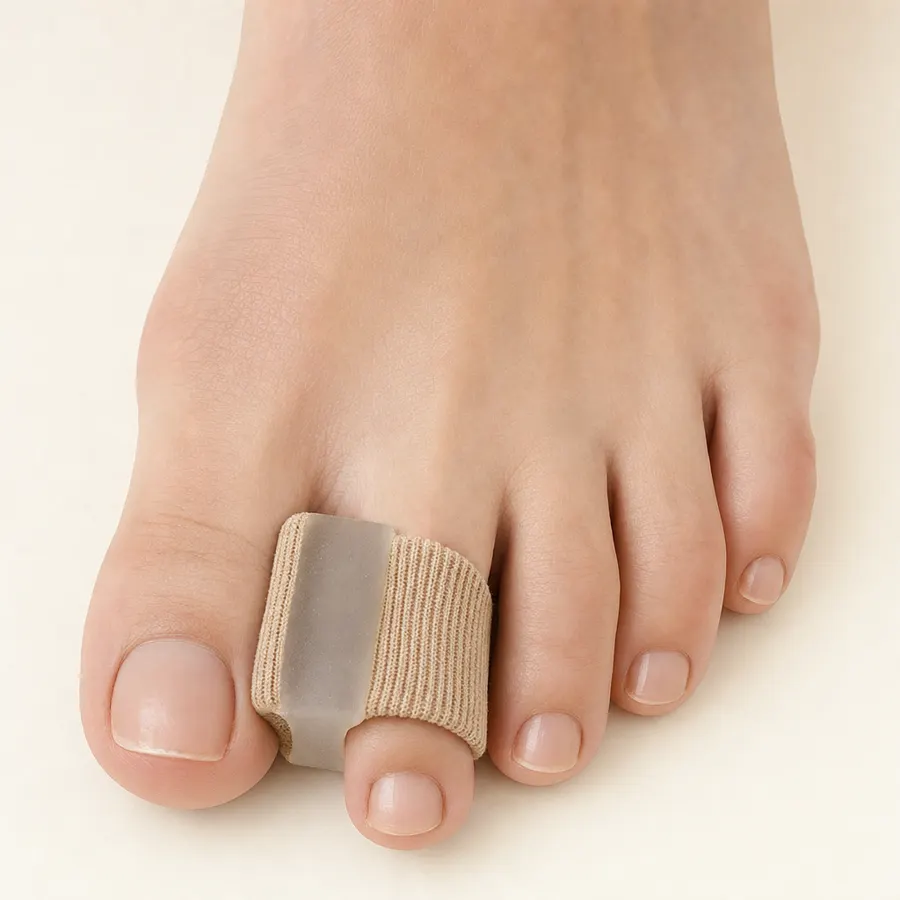
| Inside roomy shoes, targeted need | Separator tube under a sock | Slim enough to wear discreetly; spaces one problem toe |
| Evenings at home | Gel five-toe spacers | Full spread session, 30 minutes to 2 hours |
| Yoga, mobility, post-run | Gel five-toe spacers | Adds foot awareness while tissue is warm |
That is the whole system. The five-toe gel pair, $19.99 at ToeRoom, handles the at-home sessions; if you are new to it, follow the gradual schedule in my wear-time guide rather than diving into two-hour sessions on day one. None of the rows above require willpower or extra time, which is exactly why the combo sticks where more ambitious foot routines fail: the shoes work while you live your day, and the spacer sessions attach to habits you already have, like dinner, a mat session, or a post-run stretch.
The tube trick: spacing inside your shoes
Here is the part most barefoot wearers do not know. A full five-toe gel spacer is too much material to walk in comfortably for most people, and we say so plainly in our comparison with Correct Toes, whose firmer $65 spacer is the specialist tool for all-day five-toe wear. But you do not always need all five toes spaced. A single fabric-covered separator tube slipped over your big toe or an overlapping neighbor, worn under a normal sock, disappears inside any shoe with a genuinely wide toe box. Per our own 2026 measurements, the small tube is a 3 x 1.5 x 2 cm ring and the large is 3.2 x 1.8 x 2.2 cm, which is why it works under socks where a bulky gel pair never could. That is targeted, discreet spacing during the hours you are already wearing foot-shaped shoes, for $19.99 as a 3-pack or $24.99 as a 6-pack.
The mistake that ruins the combo
Do not change everything at once. The classic failure mode I see in coaching: someone discovers the barefoot world on a Tuesday, buys zero-drop shoes and spacers, and by Friday is walking 10,000 steps a day in minimalist soles with gel between every toe. Their calves, arches, and toes all get a shock at the same time, everything aches, and they conclude the whole philosophy is hype. Transition one variable at a time. If you are new to barefoot shoes, spend weeks letting your feet and calves adapt to them before adding in-shoe tubes. If you are new to spacers, build the evening habit first, 15 to 30 minutes a day, exactly as laid out in the progression schedule. Save overnight wear, if you ever try it, for last; it is the advanced class, not the entry point.
What to expect, honestly
The immediate payoff is sensory and real: toes that spread inside a roomy shoe, feet that feel decompressed after an evening session, better toe awareness in balance work on the mat. Many people in our verified reviews describe exactly that. What we will not promise is that the combo permanently realigns toes; the long-term evidence for spacers is limited, minimalist footwear research is still young, and this site does not do invented statistics. Spacers gently space your toes while worn and may help relieve pressure, wide shoes stop re-squeezing them, and that mechanical, day-after-day logic is the honest case for the pairing. It is the same standard we apply in how we test and everywhere else in our guides.
Building your setup
You presumably already own the shoes. On the spacer side, the Complete Toe Comfort Kit at $39.99 instead of $44.98 is the one-purchase version of everything in this article: one gel pair for home sessions plus six tubes in two sizes for in-shoe and targeted use. Or start smaller with just the $19.99 gel pair or a $19.99 tube 3-pack and see how your feet respond; either way you are covered by the 30-day money-back guarantee and tracked shipping. Sizing questions before you order? Email us, we answer within a day or two, and we will tell you honestly if your situation calls for a different tool than ours.